Pearson Edexcel · A-Level · History
Course version: 9HI0 · Version from Sept 2015
The making of modern China, 1860–1997 - 1 Opening up China to foreigners,…
Full specification wording
Paper 3, Option 38.2: The making of modern China, 1860–1997 - 1 Opening up China to foreigners, 1860–70: The impact of the spread of foreign language schools, teaching English and French; growing awareness amongst the elite of other cultures and ideas; the impact of missions and missionaries; the Tianjin massacre of 1870 and its immediate consequences.
Foreign language schools spread in treaty ports, teaching English and French to Chinese students, often to supply interpreters and compradors for foreign firms.
Checked against the Pearson Edexcel 9HI0 specification (opens in a new tab) on .
- Point 3 of 3
- 4 key terms
Study notes
From the checked teaching notes for this specification point.
The idea
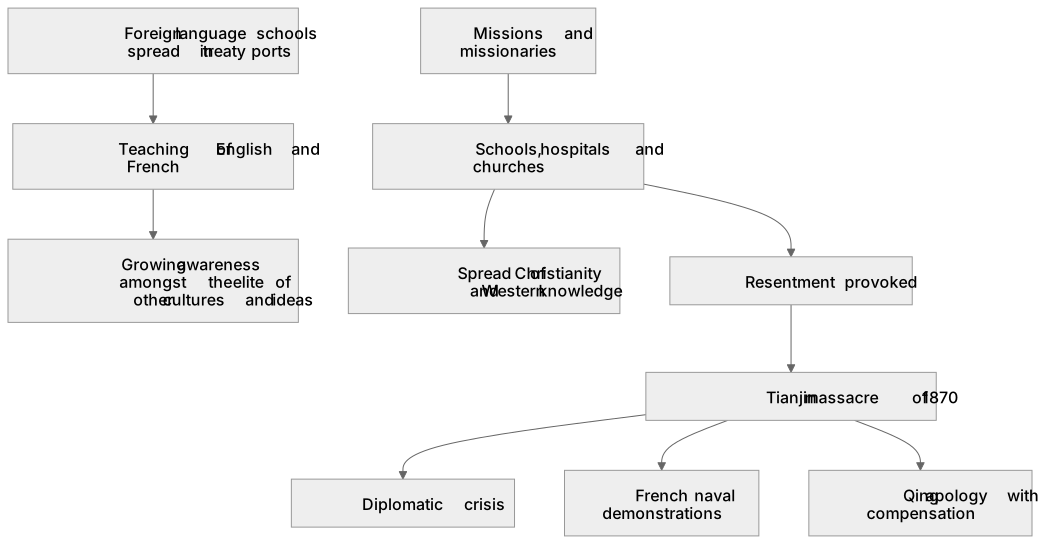
Foreign language schools spread in treaty ports, teaching English and French to Chinese students, often to supply interpreters and compradors for foreign firms. This education exposed the elite to Western cultures and ideas, fostering a growing awareness of other political and scientific concepts. Missions and missionaries established schools, hospitals and churches, spreading Christianity and Western knowledge, but also provoking resentment. In 1870, the Tianjin massacre saw a mob kill French missionaries and Chinese Christians, triggered by rumours of kidnapping and hostility to foreign influence. Immediate consequences included a diplomatic crisis, French naval demonstrations, and a Qing apology with compensation. Assess the impact of these developments on Sino-foreign relations and Chinese society.
What earns the marks
- Explains the purpose and spread of foreign language schools, including the teaching of English and French.
- Analyses how these schools contributed to a growing awareness among the elite of other cultures and ideas.
- Assesses the impact of missions and missionaries, including their educational, medical and religious activities.
- Explains the causes and events of the Tianjin massacre of 1870.
- Evaluates the immediate consequences of the massacre, such as diplomatic tensions, compensation and increased foreign pressure.
- Uses specific examples, such as the Tongwen Guan or the role of French missionaries in Tianjin.
Common mistakes and how to put them right
Assuming foreign language schools only served foreigners.
Put it right: They also trained Chinese for government and commercial roles, influencing elite outlooks.
Treating missionaries as only religious.
Put it right: Recognise their broader impact through education, healthcare and cultural exchange.
Confusing the Tianjin massacre with later Boxer events.
Put it right: Place it in 1870 and distinguish its specific causes and consequences.
Exam tips
- Structure your answer around the four clauses: language schools, elite awareness, missions, and the Tianjin massacre.
- Use specific dates and names, such as 1870 and the French consulate in Tianjin, to support your points.
- Connect the massacre to wider patterns of anti-foreign sentiment and its consequences for Qing diplomacy.
Try the lesson
The start of the Paper 3, Option 38.2: The making of modern China, 1860–1997 - 1 Opening up China to foreigners, 1860–70: The impact of the spread of foreign language schools, teaching English and French; growing awareness amongst the elite of other cultures and ideas; the impact of missions and missionaries; the Tianjin massacre of 1870 and its immediate consequences. lesson, made from checked teaching notes for this specification point.
Have a go first
What was the primary trigger for the Tianjin massacre of 1870?
Listen
Foreign language schools spread in treaty ports, teaching English and French to Chinese students, often to supply interpreters and compradors for foreign firms. This education exposed the elite to Western cultures and ideas, fostering a growing awareness of other political and scientific concepts. Missions and missionaries established schools, hospitals and churches, spreading Christianity and Western knowledge, but also provoking resentment. In 1870, the Tianjin massacre saw a mob kill French missionaries and Chinese Christians, triggered by rumours of kidnapping and hostility to foreign influence. Immediate consequences included a diplomatic crisis, French naval demonstrations, and a Qing apology with compensation. Assess the impact of these developments on Sino-foreign relations and Chinese society. A strong answer earns marks for these points. Explains the purpose and spread of foreign language schools, including the teaching of English and French. Analyses how these schools contributed to a growing awareness among the elite of other cultures and ideas. Assesses the impact of missions and missionaries, including their educational, medical and religious activities. Explains the causes and events of the Tianjin massacre of 1870. A common slip: Assuming foreign language schools only served foreigners. Instead, they also trained Chinese for government and commercial roles, influencing elite outlooks. Exam tip: Structure your answer around the four clauses: language schools, elite awareness, missions, and the Tianjin massacre.
See it
Watch it explained
What is the one idea the video explains? Say it in a sentence.
Read the described scene instead
Between 1860 and 1870, treaty ports exposed China to foreign schools, missions and diplomacy. This lesson examines language schools, elite awareness, missionary activity, and the Tianjin massacre of 1870. Think of the period through four connected developments. First, foreign language schools. Second, growing elite awareness of other cultures and ideas. Third, missions and missionaries. Fourth, the Tianjin massacre and its immediate consequences. Together they show both exchange and tension. Foreign language schools spread in treaty ports and taught English and French. They often supplied interpreters and compradors for foreign firms, but they also trained Chinese people for government and commercial roles. The Tongwen Guan is a specific example. Such education exposed some of the elite to Western cultures, political ideas and scientific concepts. Missions and missionaries established schools, hospitals and churches. They spread Christianity and Western knowledge, so their impact was educational and medical as well as religious. But their presence could provoke resentment among Chinese people hostile to foreign influence. This made missionaries important agents of cultural exchange and of tension. In 1870, the Tianjin massacre was triggered by rumours of kidnapping and hostility to foreign influence. A mob killed French missionaries and Chinese Christians. Pause and consider the immediate consequences. There was a diplomatic crisis, French naval demonstrations, and a Qing apology with compensation. The result was increased foreign pressure on the Qing. Avoid three common errors. Foreign language schools did not only serve foreigners; they trained Chinese for government and commercial roles and influenced elite outlooks. Missionaries were not only religious; they affected education, healthcare and cultural exchange. And the Tianjin massacre belongs to 1870, not to the later Boxer events; keep its specific causes and consequences distinct. From 1860 to 1870, language schools and missions spread Western knowledge and increased elite awareness, but they also provoked resentment. The Tianjin massacre of 1870 killed French missionaries and Chinese Christians. Its immediate consequences were diplomatic crisis, French naval demonstrations, Qing apology and compensation, and greater foreign pressure.
Key words
Say what each word means before you turn the card.
Cultural exchange and education
Try answering aloud or in your head before turning the card.
Missionary impact
Try answering aloud or in your head before turning the card.
Anti-foreign violence
Try answering aloud or in your head before turning the card.
Diplomacy and foreign pressure
Try answering aloud or in your head before turning the card.
See every definition
- Cultural exchange and education
- Foreign language schools spread in treaty ports, teaching English and French, and exposed the elite to Western cultures and ideas.
- Missionary impact
- Missions and missionaries established schools, hospitals and churches, spreading Christianity and Western knowledge, but also provoking resentment.
- Anti-foreign violence
- In 1870, the Tianjin massacre saw a mob kill French missionaries and Chinese Christians, triggered by rumours of kidnapping and hostility to foreign influence.
- Diplomacy and foreign pressure
- Immediate consequences included a diplomatic crisis, French naval demonstrations, and a Qing apology with compensation.
Label the diagram
Some boxes have lost their names. Pick the right name for each number.
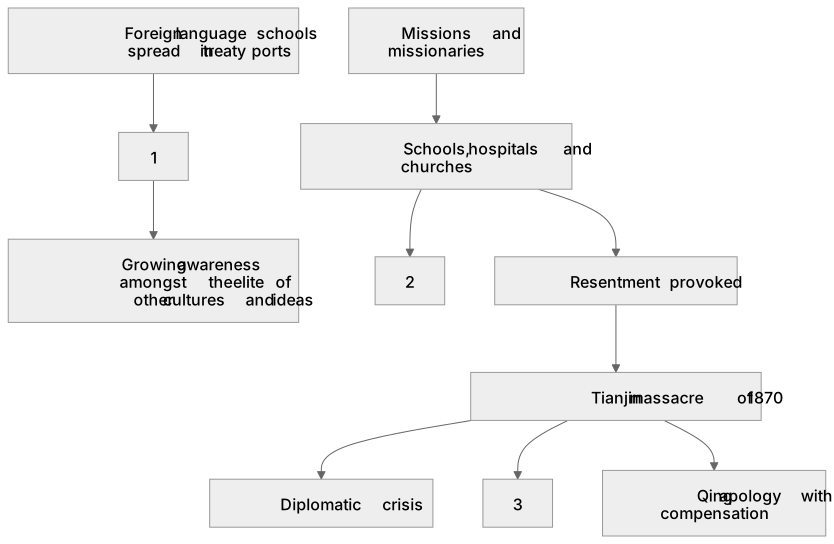
1Box 1
2Box 2
3Box 3
There is more to this lesson
The full lesson goes on to check your understanding and help you earn the marks. Create a free account to carry on, with your progress saved.
A week of Premium from your first lesson · Then the free plan continues · No card, no charge
Test your understanding of Paper 3, Option 38.2: The making of modern China, 1860–1997 - 1 Opening up China to foreigners, 1860–70: The impact of the spread of foreign language schools, teaching English and French; growing awareness amongst the elite of other cultures and ideas; the impact of missions and missionaries; the Tianjin massacre of 1870 and its immediate consequences.
Active recall beats re-reading. Take an instant quiz now to test what you’ve learned and lock it into long-term memory.
A week of Premium from your first lesson · Then the free plan continues · No card, no charge